


Ford F-150 vs. Toyota Tundra: Comparing Rugged Contenders In The Full-Size Truck Segment
Choosing between the Ford F-150 and Toyota Tundra usually comes down to how you plan to use a full-size truck, not just which badge you prefer. In any serious look at the Ford F-150 vs. Toyota Tundra, the real differentiators are powertrain choice, towing setup, cabin usability, off-road trim strategy, and long-term ownership priorities.
These two pickup truck rivals are cross-shopped because both promise strong horsepower, modern technology, and everyday versatility, but they approach the segment differently. The Ford F-150 leans into broad configuration freedom for work, family, towing, and high-performance use, while the Toyota Tundra takes a more focused path with a twin-turbo V6 platform and a simpler lineup.
This Ford F-150 vs. Toyota Tundra comparison from Crossroads Ford of Wake Forest covers the categories that matter most, from performance to reliability. When you’re ready to find the full-size truck for you, visit our Ford dealer in Wake Forest, NC, for a test drive.
At a Glance: Ford F-150 vs. Toyota Tundra
The Ford F-150 stands out because it is America’s best-selling truck and because its trim levels and mechanical choices cover more use cases than almost any other full-size truck. That breadth matters in the real world because buyers can prioritize MPG, towing, off-road hardware, luxury features, or high horsepower without leaving the nameplate.
The Toyota Tundra takes a different approach, centering the lineup around a modern twin-turbo V6 architecture with trims aimed at commuting, towing, and recreation. That simpler strategy gives the Toyota Tundra a more streamlined identity, but the Ford F-150 remains easier to tailor precisely to a buyer’s budget, trailer weight, and daily routine.
Best-Fit Buyer Profiles
Frequent towers who need the right axle ratio, tow package, and payload match will usually find more precise fitment options in the Ford F-150 lineup. Buyers who want a specific sweet-spot trim, especially in 4×4 form, also benefit from Ford’s broader menu because it reduces the chance of paying for features they do not need.
Powertrains and Performance
If you’re wondering which is better in the Ford F-150 vs. Toyota Tundra comparison, it starts with how it performs under the hood. The Ford F-150 has a broader and more strategically useful engine lineup. It offers a powerful range of engine options, including the 2.7L EcoBoost® V6, 3.5L EcoBoost® V6, 5.0L Ti-VCT V8, 3.5L PowerBoost® Full Hybrid V6, and the 5.2L Supercharged V8 in the Ford F-150 Raptor® R™, all paired with a 10-speed automatic transmission.
That range matters because engine choice changes the truck’s character more than many buyers expect. A smaller EcoBoost® engine can make sense for lighter-duty daily driving, the 3.5L EcoBoost® is a proven towing-oriented option, the V8 appeals to buyers who prefer a traditional feel, and the hybrid adds another layer of low-end response and efficiency strategy.
The Toyota Tundra is more focused, with its standard i-FORCE 3.4L twin-turbo V6 producing 358 horsepower and 406 lb.-ft. of torque, plus available i-FORCE MAX hybrid availability where applicable. That setup gives the Toyota Tundra a torque-forward personality that can feel strong in normal driving, especially when pulling away from a stop or merging with a load.
In the Ford F-150 vs. Toyota Tundra matchup, the Ford F-150’s advantage is not just peak output but calibration flexibility. A truck lineup that spans efficient V6 options, a hybrid, a V8, and halo-performance variants allows buyers to match gearing, throttle feel, and intended use more accurately than a one-engine-centered strategy. Throttle response and transmission behavior are configuration-dependent in both trucks, especially once tire size, axle ratio, and trim weight change the equation. Still, the Ford F-150 offers more ways to optimize highway composure, passing power when loaded, and low-end pull, which is why it feels more adaptable across the widest range of drivers.
Towing and Hauling
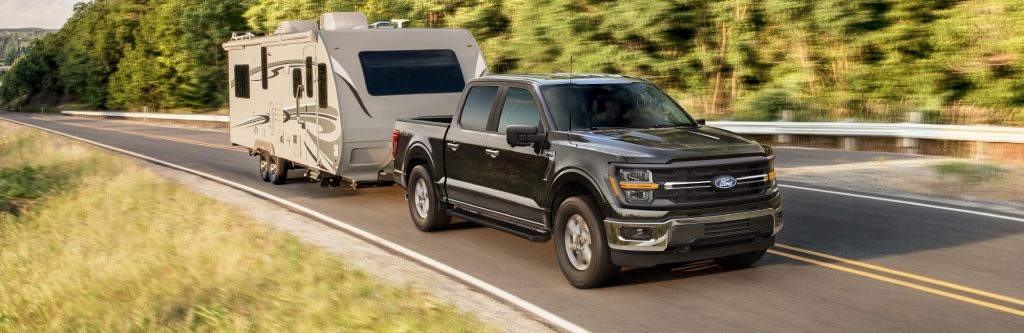
In the Ford F-150 vs. Toyota Tundra towing capacity comparison, the Ford F-150 leads this category on both ceiling and support tools. When properly equipped, it can tow up to 13,500 lbs., while the Toyota Tundra is rated up to 12,000 lbs. That gap is meaningful because trailer buyers often run out of margin faster than expected once passengers, cargo, and hitch weight are added.
Those looking to optimize the Ford F-150 vs. Toyota Tundra maximum tow ratings should consider that axle ratio, cab style, bed length, drivetrain, cooling package, hitch equipment, and tire rating can change what a truck can safely handle. The best towing truck is the one with the right build sheet, not just the highest ad claim.
Payload capacity is equally important, especially for travel trailers where tongue weight consumes payload before the trailer reaches its advertised maximum. The Ford F-150’s maximum payload of up to 2,440 lbs. gives it a practical advantage for buyers carrying passengers, tools, bed cargo, and trailer tongue weight at the same time. Meanwhile, the Toyota Tundra achieves up to a maximum of 1,850 lbs. of payload, significantly less than the rugged Ford F-150. Ford also offers a deeper towing-tech toolkit, including Pro Trailer Backup Assist™, Smart Hitch, Onboard Scales, trailer brake controller availability, camera support, hitch guidance, and trailer sway control. The Toyota Tundra includes advanced towing technology, but Ford’s system depth is more work-focused and reduces the learning curve for backing, loading, and hitch setup.
The Ford F-150 vs. Toyota Tundra bed dimensions also matter once a truck becomes a daily tool. The Ford F-150’s work-minded features, bed access solutions, and utility-oriented design make it easier to use beyond the spec sheet, which is where many trucks either earn loyalty or create frustration.
Interior, Comfort, and Tech
Step inside each truck cabin to further compare the Ford F-150 vs. Toyota Tundra.
The Ford F-150 has the more work-intelligent cabin, while the Toyota Tundra makes a strong case on modern presentation. Ford’s interior strategy emphasizes productivity with features such as an available Interior Work Surface, large console storage, durable materials, premium finishes, and a layout designed for comfort and connectivity during long days in the truck. For full-size truck buyers who often use the cabin as a mobile office, charging hub, and storage zone, the Ford F-150’s interior layout is ideal for those looking for practicality. USB-C ports, 12V and 120V outlets, device placement, and flat surfaces can matter as much as upholstery when the truck doubles as a tool for business and travel.
When it comes to infotainment, the Ford F-150 offers a standard 12-in. touchscreen with SYNC® 4 and enhanced voice recognition, while the Toyota Tundra counters with an available 14-in. touchscreen. Each configuration has wireless Android Auto™ and wireless Apple CarPlay® compatibility to streamline all of your entertainment needs. Toyota’s larger available display is a real advantage on paper, but Ford’s tech ecosystem is more integrated into truck tasks, which gives it stronger day-to-day utility.
Driver assistance is another close contest in the Ford F-150 vs. Toyota Tundra matchup. The Toyota Tundra brings standard Toyota Safety Sense™ 2.5, while the Ford F-150 offers driver assistance and safety features found in the Ford Co-Pilot360® suite, plus available Ford BlueCruise hands-free driving. Visibility and camera support also shape comfort because parking a large pickup truck is a daily event, not a rare one. Available 360-degree camera systems, trailer camera support, and parking sensors are especially valuable in urban lots and tight job sites, and Ford’s truck-centric camera and towing integration feel more purpose-built.
Reliability and Durability
Durability, reliability, and ownership cost are related but not identical in the Ford F-150 vs. Toyota Tundra comparison. Durability is about how the frame, body, suspension, cooling system, and brakes handle repeated load; reliability is about issue frequency and repair interruptions; cost is about parts, labor, downtime, and how quickly problems are resolved.
The Toyota Tundra benefits from Toyota’s long-standing reliability reputation, and that reputation matters because many buyers use it as a proxy for lower stress ownership. Even so, modern trucks from every brand are mechanically and electronically complex, so maintenance history, recall completion, software updates, and service quality often influence ownership experience more than brand mythology alone.
The Ford F-150 makes a stronger durability case for hard use because its high-strength, military-grade aluminum-alloy body and work-oriented engineering are built around payload, towing, and broad duty cycles. A truck that is configured and maintained correctly will usually age better in demanding service than one chosen mainly on reputation, and Ford’s lineup gives buyers more ways to avoid underbuying for the job.
Service records also matter more than internet anecdotes when closely looking at the Ford F-150 vs. Toyota Tundra comparison. Trucks that have towed heavily should be evaluated for hitch wear, brake condition, transmission service, rear suspension sag, and cooling system health, because those signs reveal more than a generic reliability ranking.
Off-Road Capability and Trims
The Toyota Tundra offers credible trail hardware and is easy to understand in off-road form. Available features such as Crawl Control, Multi-Terrain Select, the TRD Off-Road Package, Bilstein® off-road shocks, BBS® forged wheels, an aluminum skid plate, and the Toyota Tundra TRD Pro trim give it legitimate recreational appeal for buyers who want factory-backed adventure equipment.
The Ford F-150 responds with a wider off-road ladder that stretches from selectable drive modes and available Rock Crawl to specialized trims such as the Ford F-150 Tremor®, Ford F-150 Raptor®, and Ford F-150 Raptor R. This diverse selection allows shoppers to choose anything from a practical all-around 4×4 to a high-speed desert-oriented flagship without leaving the Ford F-150 family.
Hardware differences further define the gap in the Ford F-150 vs. Toyota Tundra comparison. Ground clearance, approach and departure geometry, shock tuning, locking capability, wheel and tire packages, skid protection, and terrain management all shape trail performance more than styling cues, and Ford’s upper-end off-road ceiling is simply higher.
Toyota’s Multi-Terrain Select and Crawl Control are useful low-speed aids, especially for moderate trails and controlled technical sections. Ford counters with drive modes and trail-control-style functionality where relevant, but its biggest advantage is that the off-road range scales upward much further for buyers who want serious capability from the factory.
The Full-Size Finale
For most buyers comparing the Ford F-150 vs. Toyota Tundra, the Ford F-150 is the better all-around choice because it solves more truck problems with fewer compromises. It offers stronger towing and payload ceilings, more powertrain flexibility, deeper trailer technology, and a cabin shaped around real work, which is why it remains the safer recommendation for shoppers who need their truck to do more than one job well.
The Toyota Tundra is still an efficient option for buyers who want a torque-forward twin-turbo V6, a large available touchscreen, and Toyota’s familiar ownership image. Even so, the Ford F-150 wins the broader comparison because full-size truck value is defined by fitment, capability, and adaptability, and Ford gives buyers more ways to get all three while still keeping fuel economy choices on the table through its wider engine range.
If you want to explore the Ford F-150 in person, Crossroads Ford of Wake Forest is a smart place to compare trims, towing equipment, and technology features side by side. Visit us in Wake Forest, NC, today!
FAQs
Is the Ford F-150 or Toyota Tundra better for towing?
The Ford F-150 is usually the better towing choice because its maximum rating reaches 13,500 lbs. when properly equipped, versus up to 12,000 lbs. for the Toyota Tundra. Ford also adds more specialized towing tools, which matters as much as raw rating.
Which truck has better engine options?
The Ford F-150 has the stronger engine spread because it offers multiple EcoBoost® choices, a V8, a hybrid, and high-output Ford F-150 Raptor® models. The Toyota Tundra’s twin-turbo V6 is strong, but Ford gives buyers more ways to match powertrain to budget and use.
Is the Toyota Tundra more reliable than the Ford F-150?
The Toyota Tundra has a strong reputation, but modern truck ownership depends heavily on maintenance, recall completion, and service history. The Ford F-150 remains a smart buy when configured correctly and maintained well, especially for heavier-duty use.
Which truck is better for daily driving?
The Toyota Tundra’s torque-rich V6 and available large screen make it easy to like in daily use. Still, the Ford F-150 is often the better everyday truck because its trim, engine, and cabin options let buyers tune comfort, utility, and fuel priorities more precisely.
Does the Ford F-150 or Toyota Tundra have better technology?
The Toyota Tundra offers a larger available 14-inch touchscreen and standard Toyota Safety Sense™ 2.5, which are real strengths. The Ford F-150 still takes the edge because SYNC® 4, available BlueCruise, and truck-specific towing and work features create a more useful overall tech package.
Which truck is the better value?
Value depends on how closely the truck fits your needs, not just the sticker price. The Ford F-150 usually delivers better value for more buyers because its broader lineup makes it easier to avoid paying for the wrong mix of capability, comfort, and equipment.
Connect with us

